
Writing the Hand That Feeds, Part 1
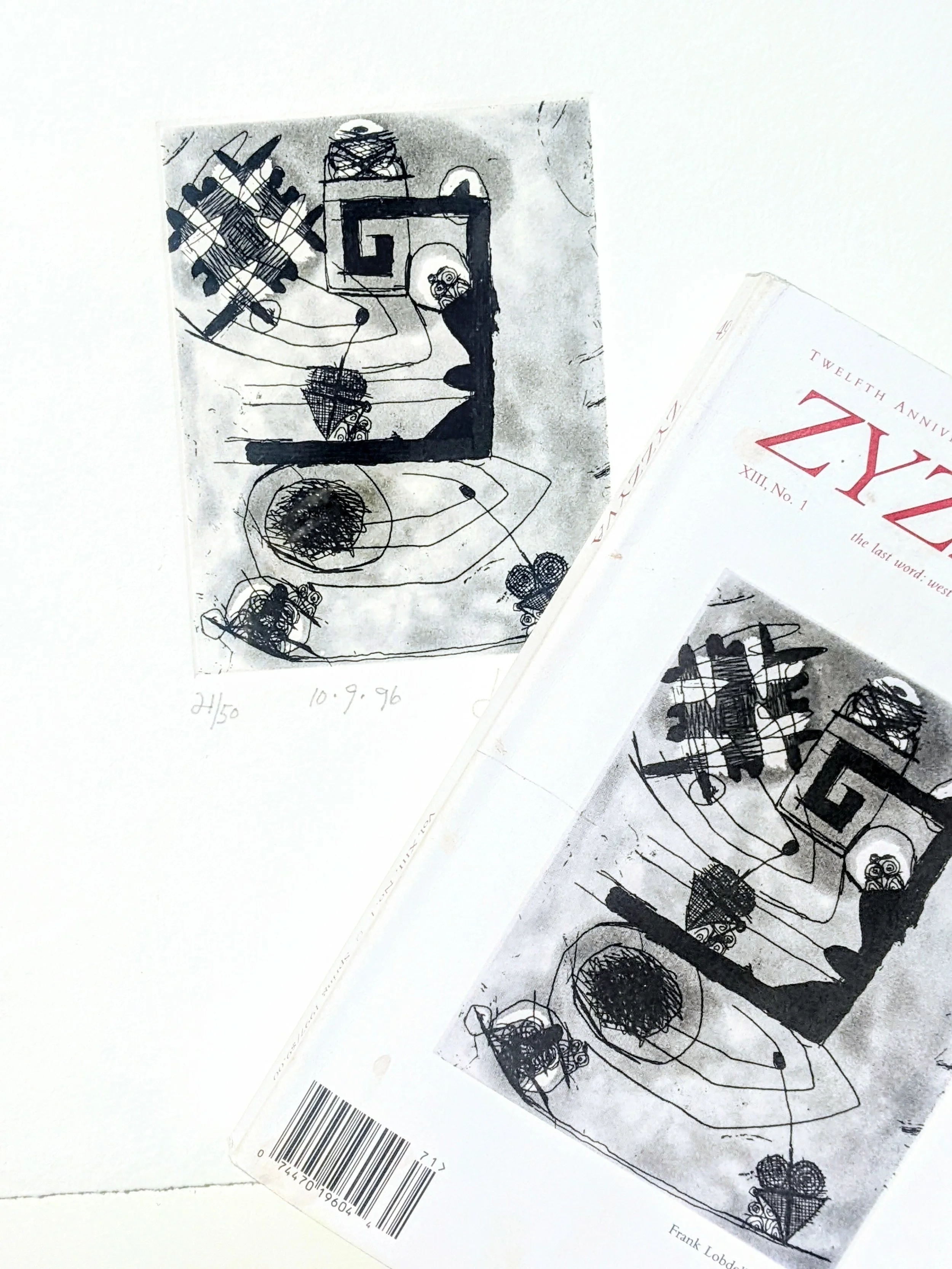
My first published story—set in the Napa Valley, of course—appeared in the Spring 1997 issue of West Coast literary journal ZYZZYVA.
I wanted to be a writer. This was decades ago, back when people still read novels in their leisure time. We decided, as a young couple, that writing about Napa and winemaking, while Kristof worked as a winemaker in Napa, was impossible because you couldn’t do it without biting the hand that feeds.
I’d published two stories before we worked this out. In “Things That Make Your Heart Beat Faster,” a fictional short story inspired by my experience working as a police officer in the small Napa Valley town of St. Helena, which appeared in the 2001 anthology Best American Mystery Stories, I wrote, “Our primary form of entertainment when we were alone was telling each other stories that demystified the Valley. He’d tell me about tanks of white accidentally pumped into tanks of red and then say, “This is a small valley. Talking ruins careers.” He’d warn me that people might try to milk me for information. “Oh, please,” I ‘d say. “You didn’t have to sign a confidentiality agreement like I did.” I’d tell him about the mystery of the naked dead man, found face-down in front of a winery chateau.”
A wife known for writing stories and sharing local secrets that showed the foibles and intricacies of human nature would negatively impact your relationships in an insular, handshake, agrarian culture that valued discretion—potentially aggravating the vintner who paid your salary. We’ll wait until retirement, we’ve continued to tell ourselves as the years have passed, then write all of our stories in one fabulous book. Along with Kristof’s trade secrets, formulas (the winemaker’s mathematical constant), and cellar lore.
It wasn’t that I was barred from writing short stories or novels, you see, just that I couldn’t write about Napa Valley and winemaking. My problem has been that I only want to write about the life experiences that have rooted me to this particular place where “we”—I now include myself in Kristof’s winemaking—make wine. I was told, “Write what you know,” as a graduate student in fiction writing seminars; it’s what I told students of mine as an instructor at University of California, Davis, when they wrote stories that sounded like they’d lifted the plot from an episode of The Sopranos.
What does it mean? It means, write about something you know to be true, even if it’s a small thing, like the time your grandmother told a bank robber to watch his language. Do it in a clear-eyed and unsentimental way that is also infused with empathy. The model here is Chekhov, who wrote about common people, like the young girl tasked with rocking a baby all night long without falling asleep herself; her commonplace despair becomes universal.
Now, as he shares his winemaking secrets with me, Kristof often says, “Most people wouldn’t have the guts to do it this way.” How I deal with reduction, he’ll say, is to keep my cellar in such and such a way, which is the exact opposite of how most winemakers do it, and they wouldn’t have the guts. If no one else would have the guts, I’m wondering, can we write about it now, as opposed to later? We’re close to retirement now. And I’m starting to think we’ll never retire.
If not now, then when? My husband has had his share of near fatalities over the span of a career in production winemaking. During the pandemic, a vineyard truck towing a fish-tailing trailer with heavy equipment on the back ran him off a back country road and kept going; his neck was broken, but he didn’t know it and walked around for a day and a night before searing pain set in.
The likelihood was high that he would die or be paralyzed, but he left surgery with no complaints other than some numbness in his thumb, which dissipated with time. If this frightened my husband, or shook him up in any way, I wouldn’t know. He still drives that same back country road, still wears the same cactus-print Western shirt with pearl snap buttons that he wore on the day of the accident, because I removed the blood stains with Oxi-clean. That’s stoicism for you.
Recently, I showed him a new story I’d written, which contained a scene based on his accident. I asked him to read it. “I love it,” he said, tears in his eyes. “But you can’t publish it. Not now.”
It occurs to me that I’ve delayed my writing career in much the same way that my husband delayed the release of our Cabernet Sauvignon label, PELLA, which he started in 2002 and named for our firstborn daughter. Eventually I started selling the wine, 17 years after that first vintage, out of a sense of pragmatic urgency; the wine may have been in its prime, but eventually wine, unlike words, perishes. He was as protective of that wine as Emily Dickinson with her hidden stash of poems, and no critic tasted those early vintages.
I’m not sure it’s relevant, but years before, a vintner had warned my husband, in a voice seeded with quiet menace, “I better not find out you’re spending more time on your wine than my wine.” We’d just barreled down our second vintage of PELLA Cabernet Sauvignon. It was an odd thing to say, since the Vintner paid Kristof a modest consultant’s fee, not a living wage, necessitating that he spend time making many different clients’ wines. So why would having his own small-production Cabernet matter?
Many vintners promote the winemakers who make their wines, in the manner a Renaissance patron might promote the work of an artist he employed. Not this one. Once, Kristof gave a phone interview on terroir to a writer for a national magazine; his quote was so interesting, it began the story: “The taste of blood. That’s how Kristof Anderson describes the saline minerally tang that the red, volcanic soils…give to Cabernet Sauvignon.” He was never allowed to give another interview.
The Vintner’s threat had a chilling effect; however, I can’t honestly say that we warehoused the early vintages of PELLA Cabernet Sauvignon for so many years instead of selling them solely because of it. Many factors distracted us from our own brand. For one, we were spread thin during those early years, as people generally are when building their careers, raising young children, and living in fixer-upper homes. It’s also possible that my husband, who craved recognition for his winemaking, might also be ambivalent about attracting attention to himself.
Not until I saw the 2021 Netflix documentary series This is Pop, in particular the episode “Stockholm Syndrome” about talented Swedish musicians who preferred producing music behind the scenes to taking the spotlight, did I understand how the Swedish cultural norm jantelagen may have affected my Swedish-American husband’s concepts of hard work and ambition. The concept of jantelagen, which as far as I’m concerned may be epigenetic, so thoroughly does it saturate the personalities of those with Scandinavian genes, discourages self-promotion in favor of humility and the deflection of praise.
Chilling effects are real. I never saw the Vintner without thinking of Robert Browning’s poem “My Last Duchess.” Once, he alarmed me by whispering one, singular word in my ear: “Comfortable?” Staff (and spouse) at a wine dinner, we had been tasked with conversing with VIP guests at cocktail hour. As we descended en masse upon the guests, herding them into intense conversations, I found the whole thing awkward and phony, the opposite of true hospitality. I broke away to admire the view of sunset from a deck chair, hoping guests would feel free to follow my lead.
When the Vintner joined me, I expected a benign comment about the beauty of his vineyards, but no. “Comfortable?” was not a question, rather a reprimand. “Yes,” I answered. “I am. Comfortable. Thanks for asking.” I stayed seated, defiantly spreading my limbs wider as if basking in the sun, even as the chill of evening descended. My point is this: the most insidious chilling effects are the ones that come from within us, the ones we impose on ourselves.
I’m reprinting my first two published stories as blog posts now. Why? My daughter Pella asked to read them. She is now close to the age I was when I wrote the first story. That’s as good a reason as I can imagine, both to rescue the stories as an archival exercise, and to reread them after many years’ passage of time. Stories you wrote at 26, when you read them at 56, make you cringe. Perhaps delaying a vocation as a writer until one can reflect on many decades of experience is not a bad thing.
Stories and novels are different from other art forms like music and visual arts, even poems, because life perspective achieved through time is necessary to make them good. It’s difficult to be a virtuoso as a story writer when young. Re-reading these, I think my stories try too hard, playing at a veneer of toughness, world-weariness, and authenticity. If the stories I wrote when young were a wine, they’d taste of oak chips. I suppose it would be worse if someone in their 50’s picked up a story written when they were 26 and didn’t see an arc of growth. Still, they are important origin stories, to me at any rate, because in rereading them, I see clearly the logic that led us to an unusual life making wine.
“Living on Holy Ground,” published in the West Coast literary journal ZYZZYVA in 1997, and reprinted here, is a fictional story inspired by experiences during our first year of marriage when Kristof and I lived on the grounds of an Orthodox Christian monastery in the Napa Valley. The story begins with a young couple taking refuge in the natural beauty and lavish feasts of a monastery and ends with them leaving, having experienced disillusionment necessary for further growth.
People forget—but I remember now—how unhappy young people can be. We assume, because of our culture prefers youth, that they must be happy in their lithe bodies with futures ahead of them, but the truth is they may work jobs that make them unhappy for not enough money to pay rent and feel baffled at the possibility of achieving a full and meaningful life. “Happy as a clam” or possibly “two peas in a pod” was how my father described us in his Christmas letter the first year we were married, to my chagrin.
Kristof had frequent, agonizing stomachaches that first year, a symptom of the unhappiness induced by having to wear a tie, sit in a cubicle, and talk on the phone as the client liaison in an enology lab. Yet those were important years, when he taught himself wine chemistry by observing lab panels and chem reports, learning everything that can go wrong with a wine, and how to fix it. “Resin, pH, and phenol,” he once told me, “that’s what’s important in a wine. That’s what I learned at the lab.” Years later, when collaborating on a research project, a UC Davis professor said, “I remember when you were in my class,” but he never was. Being an autodidact and working his way up through the cellar, cleaning tanks, added a unique dimension to Kristof’s winemaking.
There is no hacking “paradise” (the natural beauty, wealth, and glittering restaurants of Wine Country we were too poor to afford), no escaping the struggle of becoming who one will ultimately become, the foundational knowledge of a life’s work. Though it seemed, at the time, we were doing nothing much, that slow accretion of working and learning ultimately creates a life and leads to meaning.
My second story, “Things That Make Your Heart Beat Faster,” which I’ll publish in a separate blog post, is about a police officer trainee in a small Wine Country town who is fired; it’s about a failure of fit. I was writing about an experience most people will have in their lives, that of being unhappy in a job they are ill-suited to.
Kristof would have been a young assistant winemaker when I graduated from Napa Valley police academy and began my short-lived career in a town known for its humorous police blotter. The story conspires to give the reader a hopped-up mystery, when the real mystery is obvious: how we become who we are going to be, in a process of time and in a point in space. If you had asked Kristof, back then, if he liked making wine in the Oakville AVA, where he would one day have a hand in developing the style of that terroir, he might have said he wasn’t sure if it was what he wanted to do. Yet he was doing it nonetheless.
When we married and moved to the monastery grounds where we lived for a year, I was fleeing something, as refugees to monasteries have traditionally done. I was also accepting my role in life as a monastic of a different sort, someone who preserves traditional forms of culture—in my case, a love for the kind of literary analysis that had gone out of style. I had intended to get a PhD in English, but I didn’t. I was internally grieving a sense that the study of English was collapsing under the weight of postmodern theory, which is exactly what happened within two decades.
I don’t think it’s even possible to get a PhD in English anymore, only in Rhetoric, which is what English Literature (that gorgeous alchemy of aesthetic beauty, precision, logical writing, and imponderable musings about what it means to be human) became when flattened into a one-dimensional, postmodern theoretical device for advancing certain politics of resentment. I was sad at age twenty-five because I could feel this happening and didn’t think I could fight the process from within.
I was also fleeing from academia to the world of wine—and I am not the first person to do so—because one starts to weary of the realm of pure intellect and to crave the concrete world of the senses. Wine bridges them powerfully. Back in graduate school, I took refuge in the library one day after a particularly sadistic round of workshopping, and found a book of essays by Collette on flowers and fruit that revived my spirits. Is it any wonder I found myself Napa bound, when I thrilled to her scent descriptors of “nasturtium-colored roses that smelled like peaches; flimsy roses of dirty mauve that smelled of crushed ants…”?
Rereading my story, I see also that it bears the imprint of what I was reading at the time. I had discovered The Golden Bough, Love in the Western World, The Fear of the Feminine, Longing for Paradise and other books on archetypes, so every mention of a mother figure or father figure or fruitful or barren tree is glittering with archetypal significance. Becoming a mother years later, far more interesting in real life than I could have imagined, cured me of the archetypal tendency.
There’s a scene in the story in which a young, affluent grocer is invited to feast with Father Herman. He and his foodie friends rate and appropriate the Father’s authentic, ethnic peasant dishes, then later mock his eccentricities for the sake of a good laugh.
I worry I’ve done the same in my story. The real Father I knew was a priestly version of Oscar Wilde and an extraordinary gourmet. He was a lover of life, a bit of a hedonist in the mode of Colette, yet also an ascetic. Aesthete and ascetic—both—cycles of feasting and fasting interspersed, a wonderful and not impossible mix.
Years after “Living on Holy Ground” appeared in ZYZZYVA, the legendary editor, Howard Junker, drove from San Francisco to our home here in Napa. The reason was that I’d bought the cover artwork from the journal in which my story appeared, and he said he’d hand-deliver it. The print cost $400, an extravagant amount for us at the time, but I’d decided I must own 10.9.96, a hardground etching with sugarlift and spit-bite aquatint, edition of 50, by Frank Lobdell.
This came about because my father-in-law, a retired modernist architect, asked me what I thought of the cover art one time when he was visiting. I gave the cover a cursory glance.
“Um, it looks like a child scribbled it with a ballpoint pen,” I said.
“If you had said you liked it, I would have bought it for you,” he said.
The truth is, I hadn’t looked closely at it, and so for weeks after our awkward exchange, I studied the print. I wished he had phrased things differently, but he is a man who is wary of the excesses and trouble caused by language, and he communicates economically, like a rich man splitting matches in half out of the habit of thrift, so that he is never caught out, but you may well be exposed.
As often happens with something I don’t initially like but grow to love, such as mustard or grapefruit or Campari, I loved the etching and hung it on the wall to remind myself to write and publish again one day.
LIVING ON HOLY GROUND
“Living on Holy Ground” by Jennifer Anderson originally appeared in ZYZZYVA, XIII, No.1, Spring 1997, pp. 54-74. © 1997 All rights reserved.
IT SEEMS ALMOST INCOMPREHENSIBLE to almost everyone I’ve ever told that two young people like Nils and me would convert of Eastern Orthodox Christianity and move onto the grounds of a monastery in the Napa Valley. Were we that desperate for cheap housing? Just looking for a little adventure? What?
Nils and I had met at Wheaton College and simultaneously discovered the idea of Orthodoxy. Bakhtin seemed to me the sanest of the literary theorists. Nils loved Andrei Tarkovsky’s films and Andrei Rublev; he purchased books of icons. Years passed; not until we contemplated life together in the Napa Valley did we decide to become Orthodox.
To me there is a logical connection between Orthodoxy and Napa: a theology of beauty. Icons with their glistening surfaces are impenetrable beauty; so the Valley seemed to me. Orthodox Christians believe Liturgy transforms time and space so that heaven actually exists on earth, at least until the candles flicker out and the incense smoke subsides; everyone knows that Napa is a paradise. The first time I visited, as a tourist, I felt equally attracted and repulsed—the way a man might feel toward a beautiful and disdainful woman if he’d just learned she’d had major cosmetic surgery.
Nils moved here in 1991—after working the crush in South Africa. I remember thinking he might have contracted leprosy, because constant exposure to moisture had caused his hands and feet to turn white and his skin to peel off in strips. We sat in his room, in which the only object of value was a box of rare wine, and argued about a frozen pizza we’d just purchased for $0.68, on sale, at Safeway. The pizza wrapper said DO NOT MICROWAVE, but he had no other way of cooking. We sat on shag carpeting that smelled of spoiled milk. Suddenly I stood up and said, “And I thought we’d be sitting under an arbor, eating kalamata olives from a terra-cotta bowl,” and he looked at me like I was insane.
Later the same year, Nils moved in with eight other twenty-something men. Their backyard opened onto vineyards and the Wine Train tracks; next door lived a famous chef. As in a fairy tale, if any of the boys attempted to lean over the fence and talk to the chef’s wife while she gardened, he would exact revenge. Whether jealous of his wife—large, maternal, a good gardener—or his tomatoes—famously ripe—I don’t know.
Let me paint you a still life of the boys’ version of dining alfresco: a Ping-Pong table cluttered with glasses from the various tasting rooms where they’d worked, and the following bottles, in various stages of emptiness, stolen from a tasting club: ’81 Beaucastel Châteauneuf-du-Pape, ’88 Bressandes Corton, ’59 Moulin Touchais, ’81 Lagune, ’78 Mouton-Rothschild, ’79 Lynch-Bages; cigar butts mashed onto plates that had held mussels in lemongrass curry sauce and similar dishes they knew how to cook from picking up extra hours in restaurants. There were ripe tomatoes and zucchini strewn around the table; six miniature pears snuggling like nursing puppies up to a large onion; three or four splits of late harvest; and one final detail, a maraschino cherry on a sundae of decadence—a port-filled bong.
Nils would complain about petty arguments with his housemates over dishes, long-distance phone bills, and clogged toilets, but I remember thinking those boys had appropriated Eden in their young, male, cellar-rat culture. It did prove to be temporal, however, for they soon disbanded: for adventures, higher-paying industries, love.
Soon thereafter, Nils and I converted to Orthodoxy and married in a ceremony during which I fainted from the incense smoke and was revived by drinking altar wine the same intense hue as the carpet I lay on. Then Father Herman bound our hands with a white linen towel—literally tying the knot—and led us around the altar three times, counterclockwise, holding up the crucifix before us, a machete making a place for us in the jungle.
The monastery where we were married sits on a long, skinny acre of land, the Napa River running along its edge, separating it from the elementary school, which was why (someone told me) the nuns left 20 years before. First, they handed out candy to the children walking home from school. Finally, they said the children’s laughter kept them from their prayers. The property includes a prayer garden of paths and benches among wild roses, pomegranates, agave, cactus, sterile olive trees, and messy, overly fruitful wild plums. There are two gazebos, one for outdoor feasts and one for bells, and an old, uninsulated candle factory, floors slick with paraffin. In addition to the chapel and rectory, there are two small cottages and a ghostly, two-storied monastery building. From a local historian hesitant to spit it out, I learned that the monastery building originated as a tavern in the 1860’s; the hive of small rooms upstairs—used by the nuns—had originally sheltered whores.
Since the nuns’ departure, the monastery has existed in various stages of neglect. In 1994, when we moved into the guest cottage, built in the twenties according to an old Russian custom—a retired couple could build a house on monastery grounds and live there free for the remainder of their lives, but when they died, the house became monastery property—three odd souls lived on the property. Father Herman lived in the rectory on the north end. Alexey, a 13-year-old boy, and his mother, Olga, from Siberia, lived next door to us in a one-room bungalow even smaller than ours. Alexey was going through a series of reconstructive surgeries sponsored by INTERPLAST. Tourists who wandered onto the property to see the chapel’s twelfth-century Madonna, often asked Father Herman if Alexey was a victim of Chernobyl. He had to explain that, no, when Alexey was a baby, a plastic doll in his crib had caught fire, and the melted plastic burned his face, arms, chest, hands, legs. Oddly, it was often assumed that Alexey was our child, and I would have to tell the story and explain how Siberian children had thrown stones at Alexey because he was so ugly. He had a little curled hand marked with crosshatchings like scales, and a head that always reminded me of a panettone studded with candied cherries.
Because of harvest, we couldn’t take time for a honeymoon. Instead, we had Father Herman’s invitations. “I’ve made a huge pot of paella,” he’d say, “enough for 20. Help me out.” So we would. Sometimes just the three of us, other times Olga and Alexey, too. But always, in the manner of parables, assorted abnormal characters would drift in off the streets, so that by evening’s end, it would be a feast for ten or twelve. Nils, who is much more buoyant, would eat lustily, piling his plate with seconds and thirds; I was always unsettled and could hardly eat. Mostly, I drank wine and observed, and what I saw was this: Father Herman would take one or sometimes two bites, then set his fork down. Before our wedding, Nils had often driven out to the monastery for dinner; I knew that Nils had become like Father Herman’s son. I knew, without having to ask, that in those days Father had eaten everything on his plate.
I am by nature competitive. One night I decided to plan my own feast, though I knew nothing of cooking. I decided it would be a feast to make gourmets weep and angels wish for human palates. It would be at our house, and I would control the guest list. The odd drifters would be excluded—no room at the inn, I joked. It would be just the three of us, Nils, Father Herman, and me, I decided, because I had an important matter to discuss: Alexey.
I had a book, a wedding gift, called California Wine Country Cooking, that featured prefabricated menus on various themes: “A Balloon Ride Breakfast,” “Indian Summer Supper,” “Lunch in the Vineyard,” etc., and heavily filtered photos of roses and chilled globes of Chardonnay. I kept the book hidden from Nils, who has lived all his life in destination-resort towns and thus is sensitive and derisive of anything “touristy.” Will you believe me when I tell you I followed an entire menu exactly—at what expenditure of time and money I won’t say—and that everything was perfect? Of course, I could do this because I was not yet working, though our oven was small and heated unevenly, and there was so little counter space that I had to put bowls and plates of food on the floor and then watch my step and not turn around too quickly.
Here is what I prepared: phyllo cups with goat cheese, pine nuts, and sun-dried tomatoes; mandarin grilled quail; oysters in arugula cream; pickled shrimp; Napa Valley apple tart (which characteristics made it specific to the Napa Valley, the book failed to say); strawberry-amaretto custard tart; black walnut sorbet; lemon-walnut bars. There were daunting notes in the book: “If you buy shucked oysters—and unless you know how to open them, you should…Wagner’s black walnut extract is available at good specialty food stores…” I made it all, for three people, and it was all perfect.
“Here is what I prepared: phyllo cups with goat cheese, pine nuts, and sun-dried tomatoes; mandarin grilled quail; oysters in arugula cream; pickled shrimp; Napa Valley apple tart (which characteristics made it specific to the Napa Valley, the book failed to say); strawberry-amaretto custard tart; black walnut sorbet; lemon-walnut bars. There were daunting notes in the book: “If you buy shucked oysters—and unless you know how to open them, you should…Wagner’s black walnut extract is available at good specialty food stores…” I made it all, for three people, and it was all perfect. ”
The whole time I peeled and chopped and sauced (by the end, my fingers were bleeding from peeling the garlic with my nails; I had burn marks from boiling sugar), I thought about Alexey and what I would say to Father Herman about him.
When I tell people today how Alexey would peek through our lace curtains at night and watch us eating our dinner, how he would walk around our house day and night, they insinuate something like this: Do you think he ever saw you naked, do you think he ever saw you making love? They completely miss the point that Alexey wanted Nils, not me.
It had started when Alexey slid down the eroding river bank that Nils spent his weekends shoring up with rocks lifted from the river bed. Alexey said he was hunting for Bigfoot nests. Nils yelled at him, then talked about soil composition and erosion factors. Ritualistically, every evening at five o’clock, Alexey’d begin knocking at our back door, asking, “Is Nils home yet? When is Nils home?” And since it was harvest, and Nils might not come home until eight or ten or midnight, I would ignore the boy’s knocks. Then I’d see him peering through the curtains.
I laid out that first feast under tiki-torch glow, on a picnic table fragrant with candle wax. Nils had strung tiny white Christmas lights in the trees and devised roof-top flood lights. He placed three or four previously opened bottles of Caymus Special Select on the table, wine left over from bottle-sterility tests. In those days we’d drink bottles that retailed at a hundred dollars apiece until we were sick of them, and I’d even cook with this wine, adding great splashes to spaghetti sauce. I’d defrost frozen chicken breasts in it, and once I even tried rinsing my hair with it. With obvious pleasure in his voice, Father Herman said, “Oh, look at this! We really should open a bed-and-breakfast.” Then he looked at the three place settings and said, “Olga and Alexey are coming, too?”
“No,” I said. “By now they’ve eaten.”
“But this is a feast,” he insisted. So Nils was sent next door. I still didn’t expect them to come. Who comes, when invited at the last minute, food already cooling on the table? They came, out of respect for feasts.
Alexey
Alexey’d been in the country a year and a half, living with various Russians, before moving to the monastery. Though he’d only had one major operation in that time, the results were amazing. The panettone head was growing dark tufts of hair, thanks to Rogaine. He had one raw wound on his forehead, the approximate shape of Gorbachev’s birthmark. It never healed. He kept it uncovered most of the time or had a single square of toilet paper stuck to it, not taped or bandaged, but just stuck to the moist middle of it, so the edges of the square fluttered in the breeze. The crosshatchings on his face, botched results of Soviet plastic surgery, had been smoothed into putty-like patches. His body was thin and slightly twisted, but he wore surfer T-shirts and baggy plaid shorts just like American boys. He had joined the Scouts, when Father suggested he needed a social outlet.
In retrospect, one thing charms me about Alexey; he was either unaware of how horrific his looks were or else he blatantly used them to manipulate people. On Halloween, he trick-or-treated, holding a flashlight under his chin and laughing like a monster. He shouldn’t do that, someone remarked. Once he offered Nils some of his Rogaine, and his discomfited Nils, whose hair is not thinning, though he does have a high hairline. During Alexey’s birthday and name-day celebrations, when his mother would invite all the old Russian cronies with their lopsided wigs to a feast alfresco that started with Cook’s “Champagne,” he’d sit next to Nils and quietly dissect their assembled personal flaws with a razor wit.
Alexey never spoke without being within two inches of your face. Or closer. It was unbearable. “Can you play video games with me? I have new one with Ninjas and much bleeding, blood everywhere, is very cool,” he’d say. Standing by the woodshed between our houses, he would watch for Nils to come home. He’d lift a stick, sharpened and tied with totemic strings and feathers and fitted with a plastic scabbard, and swing it over his head, then bash it into the ground, gasping and wailing the whole time. Or he’d sit down, humming and buzzing, and meticulously sharpen the stick end with a pair of scissors.
Alexey’s father was in Siberia. Olga talked the doctors into another year, drew the process out, trying to get her husband into the country. Ironic, I always thought, that while Alexey was visibly improving every day, thanks to the plastic surgery, great irreparable internal damage was being done to him in his fragile adolescent state by being separated from his father. Not that I knew for sure that Alexey’s father was a good man; all I knew was that his father liked to bring stray dogs home, and that Olga would let them out in the early morning while he slept.
Father Herman did what he could, disciplining Alexey as an altar boy. Nils tutored him in English and mathematics. Olga would leave presents on our doorstep—fried piroshki, blini, fish pie, bits of fruit tart, or potato-herring-cabbing-salad—in those rinsed Styrofoam trays ground round comes in. I’d throw them directly into the dumpster, unsure how long they’d sat. Most people, when they first saw Alexey, said, What can we do for the boy? Father Herman—I loved him for this—always said, “Ask what the boy can do for you.” Alexey had four television sets, from garage sales; two VCRs; multiple video games, gifts from Rotary Club members or old ladies in the Russian community whose houses his mother cleaned for pocket money. Visitors meeting the boy made reflex judgements, telling Father what a joy it had been to meet Alexey, how bright and pleasant he seemed. They bent over backwards to say how really good he looked. The boy was obedient to his mother. He kissed the icons and lit candles and then blew them all out after Liturgy. Sometimes he complained of pain to get out of altar boy duties and then rode his bike.
Sometimes I felt terrified of the boy. Adrenaline rushed through my body when I heard Alexey’s frenetic, palpitating knock after dark. The boy had developed a preternatural interest in violence. Such an interest might seem normal for a 14-year-old boy. But because Alexey had no playmates, he seemed especially creative in his use of violence. He pressed the webbed, cross-hatched parts of his body up against sharp instruments, tools, saws, hatchets, as if he was a snake and could shed skin.
One would think a burn victim would be leery of fire, but Alexey was sloppy with the incense, and he flicked coals onto the carpet several times that could have caused fires if Father hadn’t paused in Liturgy to put them out. Alexey would dip his wooden swords into our citronella candles to make torches. (The only notable aversion to heat he displayed was in his tea drinking after Liturgy, for which he always required ice cubes.) For his name-day party, Alexey asked Nils to buy him a blowtorch as a gift and showed him a photo in the Ace Hardware flyer. Nils wanted to ask him, “Do you know what happened to you? Are you aware that you are a burn victim?” Instead he said, “What would you do with a blowtorch?” The boy said, “I would make small fires, just small ones.”
Most disturbing, Alexey had developed an alter ego, The Ninja. Then, one night, he’d become the Ninja. Father Herman was the first to see it. Father had been reading at his desk when a rock smashed through his window. He opened the door and leaned out, but saw nothing, just still dark sky, the shadowy bay and palm trees. Then he saw it, the Ninja, face and head swaddled in black cloth, wearing all black clothing and a plasticky cape and black gloves. Father bolted the door, drew the curtains closer, and sat shaking on his bed. The next day he’d spoken to Olga, and soon after that, Alexey joined the Scouts.
I felt monstrous. Sometimes when Nils went next door to repair a flat bike tire or to enlist Alexey on garbage night, I’d illogically pace the kitchen floor, trying to understand. I think a certain woman instinctively protects the energy of her mate so it is directed toward her children alone. I didn’t have children, but this passion manifested itself. I thought the boy would have been happy if I’d been dead so he could have Nils all to himself. I found myself fantasizing about having a child just to taunt and disappoint Alexey. Then I’d say to Nils, “This is your flesh and blood, pay attention to it.” I’d wield all that power. I’d think these things, pacing the floor, and then I’d realize their danger and snuff them out.
Matushka
Father Herman had moved onto the monastery property six months before Nils and me. He arrived with only a small black valise filled with seeds. The monastery gates were padlocked shut when he arrived. A lone woman stood inside, raking the dry ground and glaring malevolently at him through clouds of dust. She was the Matushka (literally “mother”); her husband, the priest, had died three months earlier. She wouldn’t open the gates, and Father Herman was too old to climb them. Finally, a neighbor phoned the fire station, and he was escorted in.
When Father Herman arrived, Liturgy had ceased for a year. Matushka had allowed no one, not even a physician, to visit her husband during his final illness. When Liturgies at the monastery had ceased, the parishioners, worried about their funerals, crossed over to the Slavonic parish. (For complex and obscure reasons having to do with accusations of KGB affiliation and the language in which Liturgies are performed, the two Russian churches located a block apart will have nothing to do with each other.) Now, with Father Herman’s arrival, the Slavonic priest warned them against returning. If something happened to Farther Herman, who was 65—the monastery was a kind of elephants’ graveyard, he implied—they would not be welcomed back.
So it was only the two of them, she in the rectory, he in the cottage where we’d later live, meeting in the chapel for vespers and Liturgy. Matushka sang, or was supposed to. Liturgy is a dialogue, it cannot be performed without a cantor. But she would develop laryngitis right before the service. He would respond by inviting nuns from Sonoma County. She would suddenly recover. She was a woman who had once broken her nose playing football, had it fixed, broke it again, and decided to leave it crooked. He was a diplomat, who had once invited one of Rasputin’s assassins and Rasputin’s daughter (who believed assassins were hiding in the trees) to dinner.
Many trials might be borne patiently, but not her cooking. She said a priest should do only two things, neither of which involved cooking. So while he read and prayed, she prepared two meals every day, insane in their lack of variation: tuna aspic and watery borscht at noon; kasha and fruited Jell-O at six. There was never wine, which he loved, being half Italian, only vodka on name-days, which she served in little plastic cough-medicine dispensers. Then she would say, “Pour the vodka, Father, the herring need to swim.”
Finally, he could bear it no more. Matushka was unmolding the tuna aspic when he told her he’d be cooking his own meals from then on. And then—he was not forthcoming about the altercation that followed, however, I picture her, what?...gripping a kitchen knife, launching the aspic at him, biting his hand. He attempted to brush past her, tripped, and bruised his ribs. She had lined the passageways with plastic mats, not a continuous strip, but myriad small mats, so the floor was uneven; worse yet, she kept a pair of bedroom slippers by the entrance to every room. After he recovered (she fed him aspic), Father Herman spoke with her son and learned she was probably not taking her Prozac.
In the midst of this struggle, the Metropolitan of All America and Canada notified Father Herman of Olga and Alexey’s request for housing and told him to prepare the bungalow next to his cottage for their arrival. Father Herman begged for relief from Matushka: “Surely she would be happier living with nuns; what do I know about handling women?” He said he knew a young convert named Nils who might be persuaded to move onto the property and take over as cantor. But the Metropolitan insisted the grieving widow remain in her home. Soon, Russian women came to Olga’s to drink tea or maybe vodka—one could tell by looking in the recycling bin by the woodshed. From one of these old ladies Father learned that Matushka had been seen washing her windows, wearing nothing at all.
Father Herman decided to look for her Prozac, just to see if she still had any. He knew when she’d be napping, and he knew that she never locked her house, a bad habit she’d formed from padlocking the gates—but Father Herman had chucked all the padlocks into the river, because they were an illegal fire hazard.
When he approached the rectory, he noticed Alexey following him. “Don’t follow me. Go play,” he said. The boy continued to follow, swinging his sword. When Father Herman turned to take it away, the stick nicked his head. He grabbed Alexey’s sword. He tried to crack the weapon in half, but could not. So he dropped it and stomped on it. Alexey laughed in a razzing, artificial manner and ran away in exaggerated strides, like a cartoon character. While searched for Matushka’s Prozac as she snored, Father Herman thought he heard the sound of stones being thrown against the wall. He was afraid Matuskha would, too, so he hurried outside, but Alexey was not there; perhaps it was his heart.
Father Herman left Matushka’s without finding any Prozac. He then walked into town to buy Comice pears. He walked and walked, ill at ease, until he finally headed home. Unlocking his door, he heard a voice coming from his feet: “Pick me up, pick me up!” Only with Alexey’s accent, it sounded like “Peek-meee-up,” slow and spooky. Father looked down and saw the tape recorder he’d lent Alexey so he could tape messages and send them to his father in Siberia. Alexey had a new trick. “I can see you now, Father Herman. Pick me up.” Chilled and confused, Father picked up the recorder, set down the fruit, and listened. “Where have you gone, Father Herman? You wouldn’t play video games with me, but now you have gone somewhere. I will find out. First I will open your door. Oh, it is locked. Why do you lock your door?”
Father Herman complimented himself on always locking his door, a habit perhaps unnecessary in a town where the police blotter printed in the weekly paper is read for comic effect: “3 a.m.: police called out to investigate someone practicing bird calls loudly find it’s a real bird.” The tape became less menacing, a boy playing at being a newscaster: “Here is a special news report of how the Ninja has terrorized the citizen-man. The Ninja has all powers. He looks through the windows and scares the Father Herman…” Father Herman pushed the stop button. Rubbish, a boy playing, hungry for attention. It could wait. He picked up his things, locked the front door, and walked two blocks to the Bank’s, the hilarious Scotch-Irish owners of a bed-and-breakfast, for dinner.
Halfway through a convivial meal of Indian curries, he heard the piercing volunteer firefighter siren. The siren sounds at least twice a night, as there are many elderly but no paramedics. He looked out the window to watch the volunteers speed south to the station, then back north! Toward the monastery building. There were two odd details: when the firefighters arrived, the gates were all padlocked, and charred sword-shaped sticks with plastic parts fitted to them were found in the wet dirt.
Father Herman
I learned my first lesson about success and failure in the elite culture of the Napa Valley–where it is chic to prefer a simple plate of olives, cheese, and bread to anything more baroque—from Father Herman, who, after heaping the parish table with steaming glazed platters of moussaka, paella, cassoulet, hummus with tahini and pomegranate, cold black bread, beet-and-blood-orange salad, figs smeared with mascarpone, iced bottles of vodka infused with contraband buffalo grass, would blush and say, “Ah, it’s just peasant food,” then commence with prayers.
“I learned my first lesson about success and failure in the elite culture of the Napa Valley–where it is chic to prefer a simple plate of olives, cheese, and bread to anything more baroque—from Father Herman, who, after heaping the parish table with steaming glazed platters of moussaka, paella, cassoulet, hummus with tahini and pomegranate, cold black bread, beet-and-blood-orange salad, figs smeared with mascarpone, iced bottles of vodka infused with contraband buffalo grass, would blush and say, “Ah, it’s just peasant food,” then commence with prayers. ”
He’d arrived in Napa around the time the new Culinary Institute at Greystone and the Wine Spectator restaurant announced its menu would be Mediterranean, which is why he’d say, “It’s just peasant food.” He’d come from Chicago. His father had been a Mafioso and in some manner this had induced him to become a monk at age 15. I remembered the story of Father Herman’s father, dying in a hospital, introducing Jimmy Hoffa to his son, “Jimmy, my firstborn.” Jimmy Hoffa looked at this son, a Russian monk, and said: “You’re shittin’ me!”
Father Herman became both a novelty and the inheritor of a subdued tradition of local color: The Russian priest before him had walked his pet rooster on a leash downtown. Father Herman was as thin as a fashion model. He wore his silver-white hair pulled into a pony-tail with an ink-stained rubber-band from the New York Times. His beard flowed down to his chest (it had reached his waist until caught in an IBM Selectric). His costume always remained the same: cassock swirling like an evening gown as he walked, belt of thick beautiful leather, wine-colored silk prayer rope elegantly knotted about his wrist. He was invited to bless grapes, dine with spa owners, vintners, local politicians.
Whenever we talked about food, he’d brusquely navigate away from specific ingredients to the Zen of cooking; how he’d started on his hands and knees, scouring latrines; progressed to the kitchen several months later, where he learned to measure flour by the span of his hand.
The 40th anniversary of his ordination fell on Halloween night, and I held a party in our cottage, which small children believed was haunted. The cake was cut, and Father said, “We really should open a bed-and-breakfast, you and I.” The cake was basket-weave almond, the top layer of my wedding cake, but we didn’t tell him. I’d replaced the cake topper with a gold candle. He thought I’d baked it for him; well, it was obviously a wedding cake.
A funny thing always happened, like clockwork, whenever Father Herman dined with us: halfway through the meal he would knock over his glass of red wine. (I always set the table with white linens.) The glass would go over, but conversation would continue smoothly, no one pausing to comment. I’d simply dump over the salt cellar on the spill, which would turn from purple to gray and then disappear into a mound of pale pink salt. He’d shown me the trick the first time, as if doing me an enormous favor.
“Zo,” he’d say, swirling the newly poured wine in his glass. “Nu.” It was an old Russian game; priests at a table for hours, just saying “nu” and “da-da” or “da-nyet,” back and forth. Then he began his stories, the same arsenal over and over. If you told him he was repeating a story, he’d just go on and finish it, then start another. We knew them all by heart, yet each time we’d hear something new for the sheer power of repetition.
“The police received an anonymous tip that a bobcat was eating a dog. When they arrived, all they saw was a raccoon. Perhaps the raccoon ate the bobcat that ate the dog,” he’d say. Sometimes the bobcat would eat a poodle, sometimes a Pekinese. I’d think to myself, what does the bobcat signify? I tried so hard to find meaning, the impenetrable logic of life, in those stories.
I realize now that his stories were a symbol for me of Orthodoxy and what I was trying to understand about it: the burden of repetition. Not only was the same Liturgical dialogue repeated every Sunday, but the events of history, from Eden to Experience, were also incessantly cyclical. Protestant Easter is a remembrance. The preacher says, “A long time ago Christ died and rose again” and launches into an anecdote. But for the Orthodox, the whole burial and resurrection must be relived. It seemed insane and inefficient to me, the first Pascha service I attended, that people wept over an effigy of Christ in a tomb, in a room fragrant with candle wax and carnation sprays. I sat in the car during the feast that followed and decided my bad mood was due to fatigue. (It was three a.m.). Not until I knew Father Herman did I realize that repetition was a kind of depth I could not fathom. By then Father Herman had become a living symbol for me of Orthodoxy.
When we’d converted to Orthodoxy, we liked the idea that we were escaping the cult of personality, the preacher who will always be vulnerable to mood and whim and error. We were given a chance to test this idea one sad, gloriously warm Saturday morning when Father Herman was preparing to drive to the convent, a striking mixture of ornate Russian style and boat dock, to tonsure a nun. He couldn’t find the nun’s hat made for the occasion from a gallon ice cream drum, draped in black polyester. I think he was afraid of the woman he was to tonsure, because he’d spoken of her before as the “iron maiden.” She had a Ph.D. in linguistics and liked to ram her learning and spirituality at him.
So he accused Nils of stealing the hat. Nils and I were gardening, incorporating compost into the soil, when he found us. Father Herman had purchased $168 worth of impatiens and planted them in a border around the monastery and then let them die because the water bill was too high. He turned to Nils and said, “I’ve put up with you long enough. You’re malicious and tone deaf as well. And now you purposely stole the nun’s hat to make me look bad.” He kicked one of the fleshy impatiens I’d watered until it had become a small tree and said, “It’s all I needed, like a hole in the head, to drive an hour and a half on an empty stomach to hear the confessions of a bunch of nuns!”
Nils grabbed Father’s elbow, Father yelled, “You’re hurting me,” and ran away.
In the next general confession, I had to kiss his hand. He said, “Forgive me for my sins,” as always, and truly, the words did not change, though the man had. It was like kissing raw liver.
I thought of raw liver the whole time I searched the classifieds for rentals and made lists to show Nils, who insisted we had a responsibility to stay until Father Herman received help. I crumpled the newspaper into balls, threw them at Nils, and told him I felt that if we didn’t leave immediately, a tragedy might occur. Months passed, during which Nils and Father Herman never spoke, except to sing Liturgy.
There was one last feast, civil and careful with some of the pleasures of earlier ones. Father Herman invited the young owner of the new gourmet market, his girlfriend, the store manager, and her fiancé to a meal specifically designed to impress and delight. We knew, though Father didn’t, because it wasn’t in the book Napa, that this young grocer’s father was a Big Man in the wine industry, and I made Nils promise not to try to advance his career, as he would feel obligated to, by offering his résumé during the meal. The grocer didn’t know, but Nils had once been to his father’s house for an interview; the man bounced a tennis ball with a racket the whole time he interviewed Nils, agitating the quail in a large aviary.
We reached for our glasses like nervous guests at a cocktail party, watching for Father to drift into an insane tirade about stolen nuns’ hats, but he didn’t. He fussed about the dishes of side salads and was charming in an old man’s eccentric way, though he avoided speaking to either of us the whole evening. We were invited, I thought, pointedly, to show us he had other young friends and didn’t need us. He also invited a few elderly Russians and Olga and Alexey.
Father Herman had used a permanent marker to write each person’s name on a tangerine. The grocer and his girlfriend had quarreled, so he came alone and quite late. Two tangerines remained unclaimed. Long after we’d given up on them, the chubby, preppy manager and her wine-boutique fiancé came, with a bottle we knew to cost about $5. Apparently, they had modest expectations. The Russians chatted in Russian, for Olga’s benefit, and once they’d drunk vodka began to sing folk songs. Nils had brought six or eight bottles of wine from the enology lab, all quite complex. Instead of scraping the labels off or wrapping the opened bottles in foil to protect client identities, he’d soaked the labels off and made new ones by photocopying icons on sticker paper. “What do we have here, altar wine?” boutique-boy said, tapping St. John of Chryostom’s face. But we drank from the opened bottles, not the $5 gift wine.
The side dishes and salads were arrayed in glorious plenitude on the table with its plastic tablecloth and paper towels folded in thirds and mismatched place settings. I remember deviled eggs with salmon, beet greens, artichoke salad, roasted beets with shallots, rice salad, roasted peppers, marinated olives, cold vegetables in mustard sauce, coleslaw, green beans in balsamic dressing, plates of salami and cheese, and a salad of red onion slices and orange segments, sprinkled with pomegranate seeds, and taramasalata. (Father was a fool for taramasalata, sometimes he’d eat a whole bowl by himself.) Unfortunately, typical of his authenticity, Father Herman had decided to serve grilled, bunless hot dogs as the main course. Not blini or saffron paella or pasta with steamed clams and tiny squid or chicken with figs and wine, as I’d seen him serve so many nights to drifters and lunatics from the street. Of all nights, hot dogs.
“The side dishes and salads were arrayed in glorious plenitude on the table with its plastic tablecloth and paper towels folded in thirds and mismatched place settings. I remember deviled eggs with salmon, beet greens, artichoke salad, roasted beets with shallots, rice salad, roasted peppers, marinated olives, cold vegetables in mustard sauce, coleslaw, green beans in balsamic dressing, plates of salami and cheese, and a salad of red onion slices and orange segments, sprinkled with pomegranate seeds, and taramasalata.”
I remember a dense, shockingly flavorful mustard that one of the old Russian ladies made at home. An embarrassing exchange began between the grocer and her about the mustard she’d made commercially years ago, stopping because of the labor-intensive process. He expressed interest in selling her product, and she said she’d see what she could do. It was not clear who was doing whom a favor in the end. The grocer thought it might be clever to sell the mustard in recycled jars, pickled herring or maraschino cherry jars—like those she served hers in.
The foodie guests did not speak, except to quietly rate Father’s various side salads, regarding which might be good in their deli. They especially liked a creamy slaw with dates and crunchy fennel. I don’t think Father could hear their quiet shop talk. The grocer would then turn away and ask Father what was in such-and-such a salad, and Father would tell—in detail!—but not the meandering stream of consciousness about staving off poverty with an egg and a handful of flour, scrubbing latrines. The foodies summed up his hummus as very much like that in their deli, with the addition of pomegranate seed. An interesting sandwich might be made with a base of his peasant caviar of eggplant. A nice vegetarian sandwich with goat cheese or something. I thought their surreptitious comments the height of rudeness.
I think Father feared they might be bored, so quiet did they seem; every once in a while, with an eruption of vivacity, he’d pour vodka into everyone’s little plastic medicine dispenser and give a toast, and we’d all have to drink. So, before long, everyone was terribly, gleefully drunk.
“What is this vodka? Fantastically flavored! What’s in this?” the grocer asked.
“Zubrovka, Polish buffalo grass. It’s illegal in this country.”
“Oh? You get a buzz?”
“No, carcinogenic. Ah, but what do the Feds know?”
To entertain his guests, he passed around a mildewed card from the thirties that said, “I cannot read or write English. I want to vote Democrat.” Also, a faded photo-postcard of a woman feeding chickens on a ranch in Fontana. She was, he said, a descendant of Napoleon and Peter the Great.
Toward the end of the evening, the grocer, uninhibited and perhaps anonymous in the way one feels in a foreign country, began delivering his Philosophy of Food and Why He Became a Grocer. He was a product of privilege, he admitted, who’d flunked out of college and squandered a series of plummy jobs in the industry. Finally, the time came for him to buckle down, and he thought, what really mattered to him? Eating was the only thing he could think of that he really liked. And, come to think of it, food was universally important, everyone around the world liked food. His mother, he said drunkenly, made sandwiches of mayonnaise and raw sliced onion, and, when toasted, the mayonnaise became wonderfully warm. So simple, but you can’t imagine how good that warm mayonnaise is, he said. He veered off into silence.
The night ended. I remember thinking, walking home, that despite the awkwardness, the foodies would probably reflect on the experience and be impressed. They’d had a unique experience, tasted real ethnic delicacies. Expensive wine had flowed freely.
But here is the sad part, the still painful part. The next day I stopped at the market on my way home from work. Perhaps the grocer didn’t recognize me in my calfskin heels and cashmere jacket; perhaps I was camouflaged among the racks of zebra-striped, squid-ink lasagna noodles. I heard him unmistakably describe the dinner, the baked-goods table shaking under the weight of his laughter: “Plastic tablecloths, my god! All these Russians drunk out of their gourds on altar wine. And the old priest, thinking he’s Brillat-Savarin, and he’s just heated up a package of Oscar Meyer weenies.”
Drifters
Father Herman’s insanity had the quality of Lear’s, in that it derived from love and thus was a perversion. Nils, who before our marriage had been the object of his affection, now became the object of his insanity. Before our marriage, the two men would dine alone. After our marriage, I noticed that Father Herman could not bear for just the three of us to dine together. For me, I think, he felt neither affection nor hatred. Because of Nils, he required a brotherhood, a paranoid “us” against “him.”
The night of my first dinner party, when I’d invited Father Herman to a feast alfresco, he insisted that Olga and Alexey join us, and then, to consummate my dismay, I saw two lost souls drifting across the property toward us in the twilight, like moths attracted to the glittering lights. They introduced themselves as Pete and Seraphim. They would stay, like the rainy season, two years in a row. Pete and Seraphim made a lifestyle and a career of considering and postponing the decision to become monks. Every impulse I had was toward disliking them. I could not be in their presence without feeling hysteria, like a pet rabbit transported to its new home in the trunk of a car, unless I’d drunk at least one bottle of wine. After a bottle of wine, I’d feel almost fond and tender toward them, an important lesson in hospitality.
Pete and Seraphim would work the crush and stay in the abandoned monastery building free of rent. They were supposed to make improvements, but never would in the end, for Father Herman worried about their frail bodies. Pete’s parents were Finnish Lapps; he had reindeer features. He whispered, “In Velam, a monastery in Finland, pineapples grow, despite the arctic climate,” as if offering a jewel as payment. Both wore crud-colored clothes buffed through long use to downy softness. Both had long hair and wispy goat beards and spoke inaudibly. Pete had psoriasis and eczema. They were small, bendable, wiry, as though from humility.
Their major business scheme was to buy broken-down Datsuns for a hundred dollar apiece, hoping to transform them into commuter cars so they wouldn’t have to bum rides. They also hoped to sell them to French, Kiwi, Australian, South African oenology interns in need of cheap transportation. Late at night they’d bang on our door and ask us to move our cars out of the carport so they could do mechanical work; local ordinances prohibited car repair on city streets, including flat-tire repair. There would be late-night requests to borrow extension cords and flashlights. Late nights of sick engines turning over and interrupting our precious, carefully measured hours of sleep. They’d also ask for something—anything, they weren’t picky—hot to drink. I’d curse silently as I handed them gourmet cocoa in Styrofoam cups.
Occasionally, Pete would come home from the first shift and wander over, disheveled, bearing half-full bottles of wine from the tasting room. Because Seraphim worked second shift, Pete would pin notes on his bedroom door: “Had a whole duck and vegetables baked in a clay pot!” Assembled, these notes would narrate a honeymoon. But mostly, from that point on, the three of them, Father Herman, Pete, and Seraphim, would dine alone at their end of the property, confident that we dined at the opposite end, counterweight.
In January, 1995, the rains came, and they insulated us for a brief time. I loved rainstorms, because no one knocked on our door. I’d lie in Nils’s arms at night listening, and I’d know our closeness was paradise. One night I fell asleep to the sound of rain, thinking how the ground was already sodden, where would it go? And when I woke again in the darkness—I’d been dreaming of the ocean—the noise had intensified tenfold and was accompanied by vibrations. I realized our house was a ship in the midst of breakers. Nils turned on the exterior flood lights, and we saw that the gentle trickle of river where an otter had been fishing the past few days had quickly engulfed us. The brown surge of current pressed almost against the window panes and had covered all but the tops of the trees, some of which had been uprooted and were forming a dam. For an awful moment, we were unsure if we were floating already or were about to be dislodged.
The fire department came and switched off our power and waited as we locked our doors. Father Herman, Olga, and Alexey waded to the homes of Russian friends, while we argued in the middle of the street, pelted by rain. I don’t know why, of all things, but I was holding a turkey I’d taken from the freezer. It was heavy, and cold, and I had the partially formed idea that if Nils loved me, he should take the turkey out of my arms. He said the streets were too flooded to drive anywhere. I told him a number of things—that I’d be damned, that I’d leave the marriage—before I’d consent to sleep at the fairgrounds, where evacuees from the nursing home would be wetting themselves and wandering about in confusion. I might have started walking down the street with my turkey, when the Presbyterian minister across the street ducked out and told us we must stay the night with his family. Just across the street from us, but oddly safe. We didn’t know them at all, and I remember how self-conscious I felt walking into their house, which seemed unnaturally hot and bright. I was just like Pete, holding out my frozen turkey like a hostess gift in return for hospitality I couldn’t repay, like an arctic pineapple.
Nils visited the dark, swirling site a few times during the night, his vision confined to a dim flashlight’s circle. He reported that our house was intact. The river level was receding, though it still lapped into the crawl space. For the next few days there was a feeling of carnival, as pumpkins, wine barrels, shopping carts, icons, grape bins, pallets washed down the river. Then the water receded, and these objects ludicrously remained stuck in the highest tree branches, taunting us.
I took a job as a communications manager at a high-tech firm, which meant commuting, long hours, and weekends at conferences. I found it trivial work; it therefore trivialized my life. But I did it because the house, which never seemed warm or dry after the flood, had filled with refugee mice; we called it the “mouse brothel,” because it had a feral stink, and you could sit on the couch and watch them dart across the room. We grew tired of disposing of traps. In the mornings I would find mouse shit in my shoes and snag my hose on the splintered floorboards. I found mouse shit in the zippered canvas garment bag holding my wedding dress and veil.
The Orthodox Christian marriage ceremony is terrifying in its brutal recognition of permanent alliances of flesh and spirit. It is nothing like the ceremonies where couples stand in Emersonian gardens and read vows they’ve written themselves: I promise a and b but not c; or even, I promise nothing, but I hope. Our ceremony was rather a ritual binding of souls, as frightening to me as any black magic in its repetition of symbolic actions. We held matching candles with gummy gold crosses, first lit for our chrismations and since packed in tissue for the final ceremony, our funerals. We wore martyrs’ crowns—marriage a form of martyrdom—and drank water mixed with wine from the same cup of suffering. If you’d asked me, in the beginning, to define marriage, I would have been wrong. I would have said it derives its primary definition from romantic love, and I would have wrongly defined “romantic.” Now I would say marriage is a ritual union carrying the entire weight of history, replete with ghosts of fire, flood, and insanity.
In the summer, as our first anniversary approached, Pete and Seraphim returned and sensed a change. Where were the twinkling lights that meant dinner parties? Gone, replaced with tense work and invisible barriers. Even Alexey seemed reined in, like a dog behind an invisible fence, walking in small circles around his cottage with assorted toys pressed close to his face. And then a slow-witted, thick-waisted, hungry youth named Jehoshaphat, who shared Pete and Seraphim’s penchant for collecting broken-down cars, moved into the monastery, followed by a cold, cerebral, Berkeley post-grad in mathematics and linguistics I resented for chain-smoking inside Father’s house, even as Father succumbed to cancer. But this was before we knew he had a brain tumor or thought to question its effect on the cognition and personality of man we had once known to be loving and a lover of life.
These were his new fellows at table and heirs to the hive of rooms that had once housed whores and nuns. This, I thought, was how it was meant to be, a monastery of sorts, though I shuddered. I thought of his meals as pantomimes, reduced as they were to the most abstract elements. Every meal would begin, “Ah, it’s just peasant food.” The same stories, obscure, impenetrable, precious reductions of a life, would be repeated to unhearing but politely hungry heads on a nightly basis, the wine glass would tip over like clockwork, and, after a while, he’d lapse into a string of “Zo...da-da,” meaning nothing and everything, fusing spiritual mystery and the absurd, the deep and the trivial.
We saw our chance and left, as though escaping for our lives. I realize now how, superstitiously. I’d once felt we must be protected there, that there must be some special blessing there, while living on holy ground. Now it seemed sterile, ill-kept, degenerating. Occasionally, ridges of dirt loosened by the flood would collapse and increase the margin of loss.
END.
This is a work of fiction. Names, characters, businesses, places, events, locales, and incidents are either the products of the author’s imagination or used in a fictitious manner. Any resemblance to actual persons, living or dead, or actual events is purely coincidental.
“First Off…(Notes From Production)” © 2020-2026. All Rights Reserved.
To read Jennifer’s latest fiction and wine-related essays, see her Substack, @grapewife.